
When Complexity Becomes a Liability: Enterprise Products in the Age of AI Agents
For decades, enterprise-grade software carried an implicit trade-off: more scale, more control and more reliability usually meant more process, more configuration, more specialist knowledge and longer implementation cycles.
For decades, enterprise-grade software carried an implicit trade-off: more scale, more control and more reliability usually meant more process, more configuration, more specialist knowledge and longer implementation cycles.
That trade-off was often accepted as the price of operating in complex organizations.
But the assumption is now under pressure.
Complexity is no longer automatically accepted as the price of enterprise-grade software. In the AI-agent era, every layer of complexity must prove that it creates business value — not just dependency, friction or hidden cost.
Why this matters now
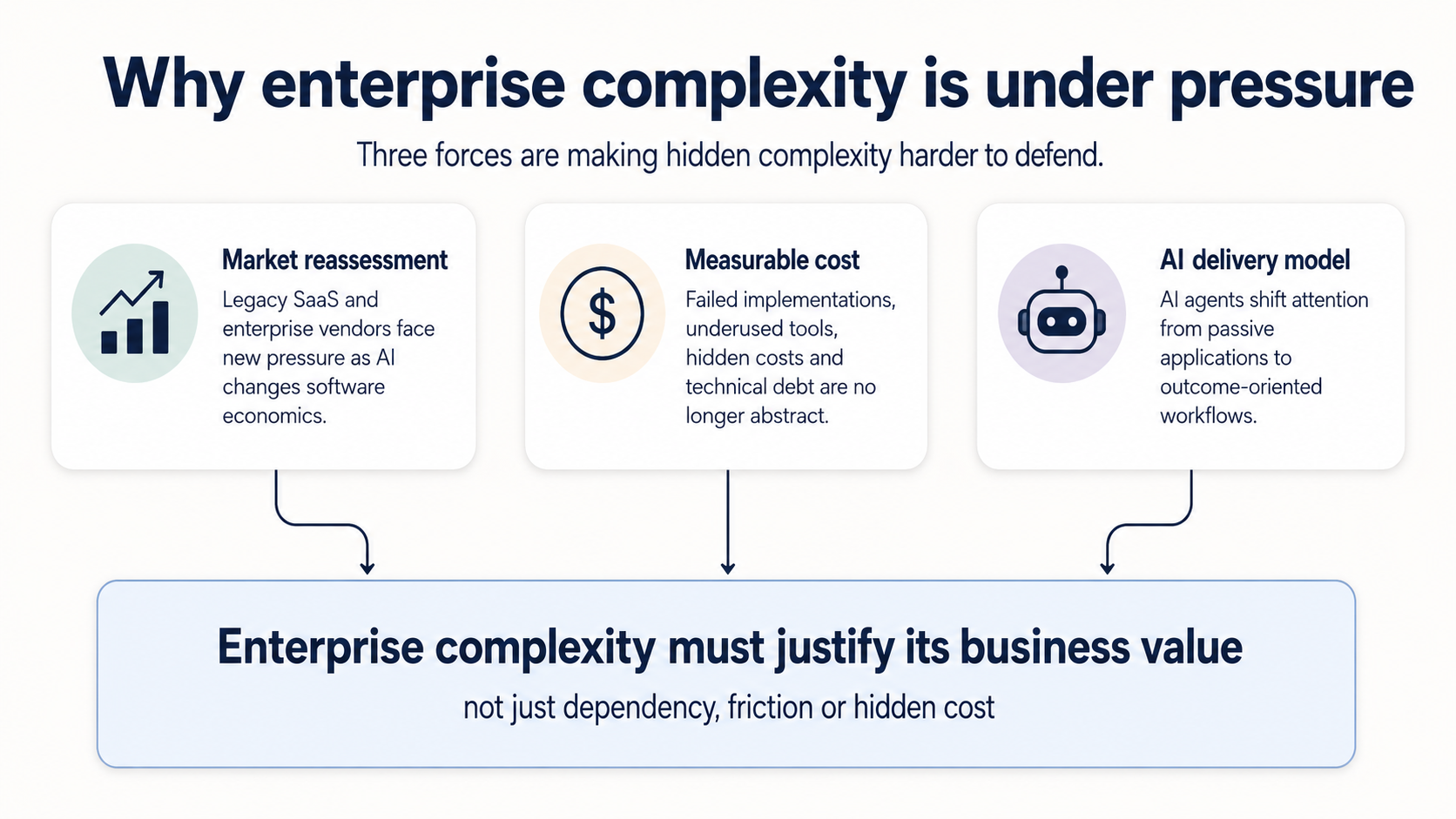
This is not only an architectural concern. It is already visible in the market, in software economics and in the way organizations are redesigning delivery models.
First, the market is reassessing legacy SaaS and enterprise software vendors. In 2026, Reuters reported warnings from Bridgewater’s CIOs that AI may create an existential challenge for legacy software companies, comparing the moment to Amazon’s disruption of traditional bookstores. Reuters also reported that the S&P 500 Software and Services Index had fallen 16.6% year-to-date amid AI-related concerns.
In another Reuters analysis, software companies were described as actively defending themselves against fears that AI could undermine parts of the traditional SaaS model. The concern is not that all software disappears, but that AI agents may increasingly perform tasks that were previously mediated through enterprise applications.
Second, enterprise software complexity already has a measurable cost. Freshworks’ Cost of Complexity research found that companies waste $1 out of every $5 spent on software because of failed implementations, underused tools and unexpected costs. The same research highlights that organizational complexity can cost around 7% of annual revenue and that employees lose almost seven hours per week to complexity.
Technical debt shows a similar pattern. Pega and Savanta estimate that the average global enterprise loses more than $370 million per year because it cannot modernize outdated systems and applications efficiently.
Third, AI is changing the delivery model, not just the tooling. Gartner predicts that by 2028, 90% of enterprise software engineers will use AI code assistants, with the developer role shifting from implementation toward orchestration, problem solving, system design and quality control.
Gartner also predicts that by the end of 2026, up to 40% of enterprise applications will include task-specific AI agents, compared with less than 5% today. This points to a shift from applications as passive tools toward applications as workflow actors.
But AI does not remove the need for architecture.
Gartner warns that more than 40% of agentic AI projects may be cancelled by the end of 2027 because of escalating costs, unclear business value or inadequate risk controls. McKinsey makes the architectural point clearly: scaling agentic AI requires governed reusable data assets, shared foundations, standards and infrastructure that can support orchestration across the enterprise.
In other words, AI does not eliminate enterprise architecture. It makes weak architecture more visible, more expensive and harder to hide.
The old logic of enterprise complexity
Traditional enterprise platforms were designed for organizations where scale, control, compliance and integration mattered more than speed of change.
Their complexity often reflected real needs:
- security;
- auditability;
- master data;
- process control;
- transactional consistency;
- segregation of duties;
- regulatory reporting;
- operational resilience.
But over time, not all complexity remained purposeful.
Some complexity became architectural debt. Some became vendor lock-in. Some became dependency on a small number of experts.
Some became implementation folklore: business rules hidden in scripts, customizations, spreadsheets, local workarounds, undocumented ETL logic, fragile integrations and “only one person knows how this works” situations.
In a stable delivery model, this was expensive but survivable.
In an AI-accelerated delivery model, it becomes a strategic risk.
Why AI changes the equation
AI does not simply make developers faster. It changes what organizations value in systems.
A system that is modular, well-documented, API-enabled and semantically clear becomes easier to automate, test, explain and extend.
A system that is opaque, heavily customized and dependent on tacit knowledge becomes harder for both humans and AI agents to work with.
This is why the risk is not “enterprise software versus AI”.
The real risk is opaque enterprise complexity versus AI-enabled delivery.
If a business process can be understood, described, tested and exposed through controlled interfaces, AI can help accelerate it. If the process is buried across undocumented screens, scripts, exceptions and manual handovers, AI adoption becomes slower, riskier and more expensive.
The role of development teams is changing as well. Developers, testers and analysts are not simply being replaced. Their work is increasingly shifting toward orchestration, validation, system thinking, domain translation, quality assurance and governance of AI-supported delivery.
That shift makes knowledge transfer, documentation, metadata, lineage, testability and architectural clarity much more important than before.
Complexity now has a visible opportunity cost
The cost of complexity is no longer theoretical.
When one team can deliver a governed, AI-assisted workflow in weeks, while another team needs months of onboarding, vendor configuration and knowledge transfer before producing the same outcome, the second model becomes harder to defend.
The question becomes uncomfortable but necessary:
Is this system complex because the business domain is complex — or because the architecture, product model and implementation history made it complex?
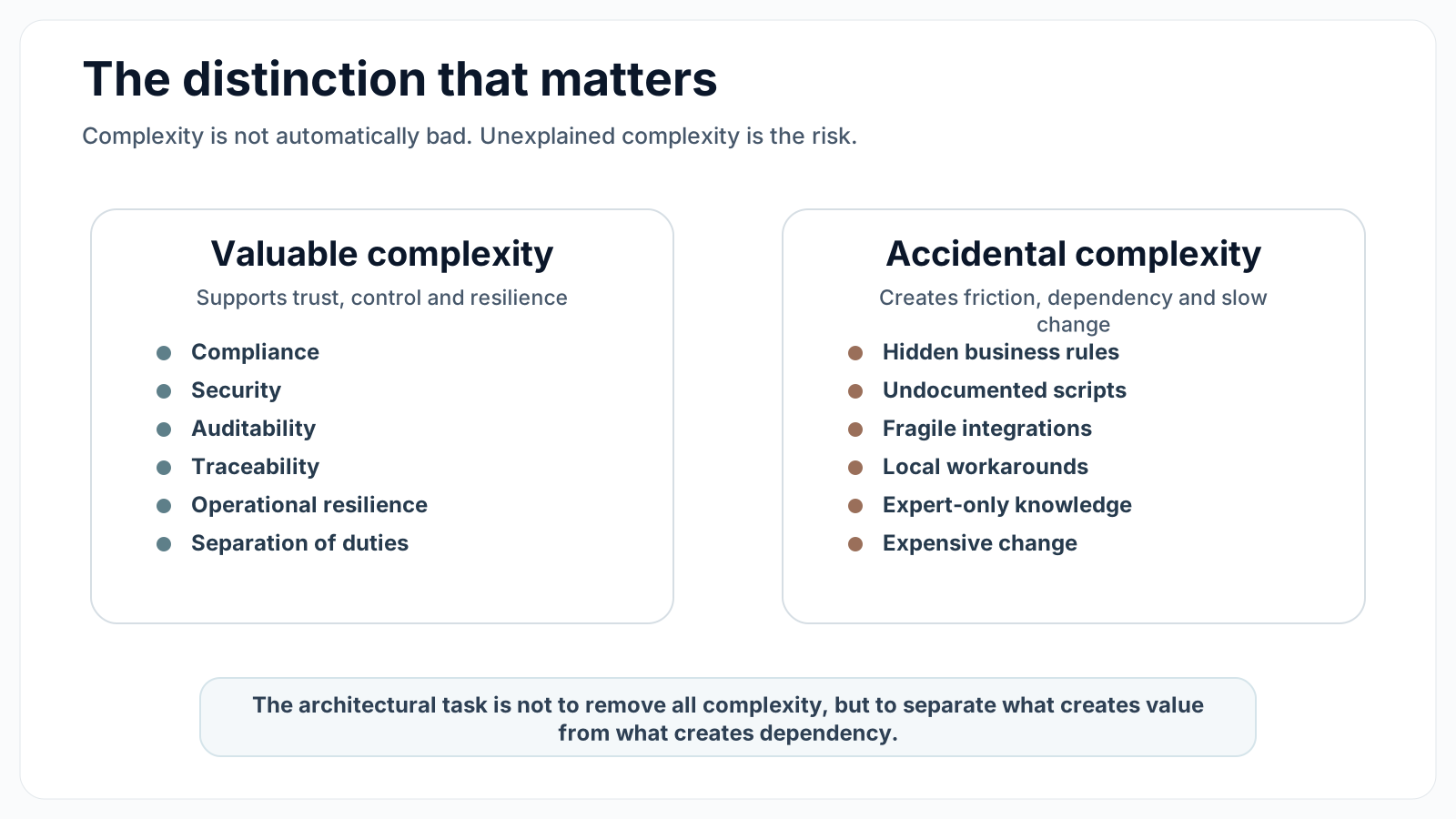
This distinction matters.
Valuable complexity supports compliance, resilience, security, traceability and operational control.
Accidental complexity creates friction, dependency, slow onboarding, hidden logic, expensive change and fragile delivery.
AI does not remove the need for enterprise-grade systems. But it raises the bar for explaining why enterprise complexity exists.
The strongest products will not be the simplest
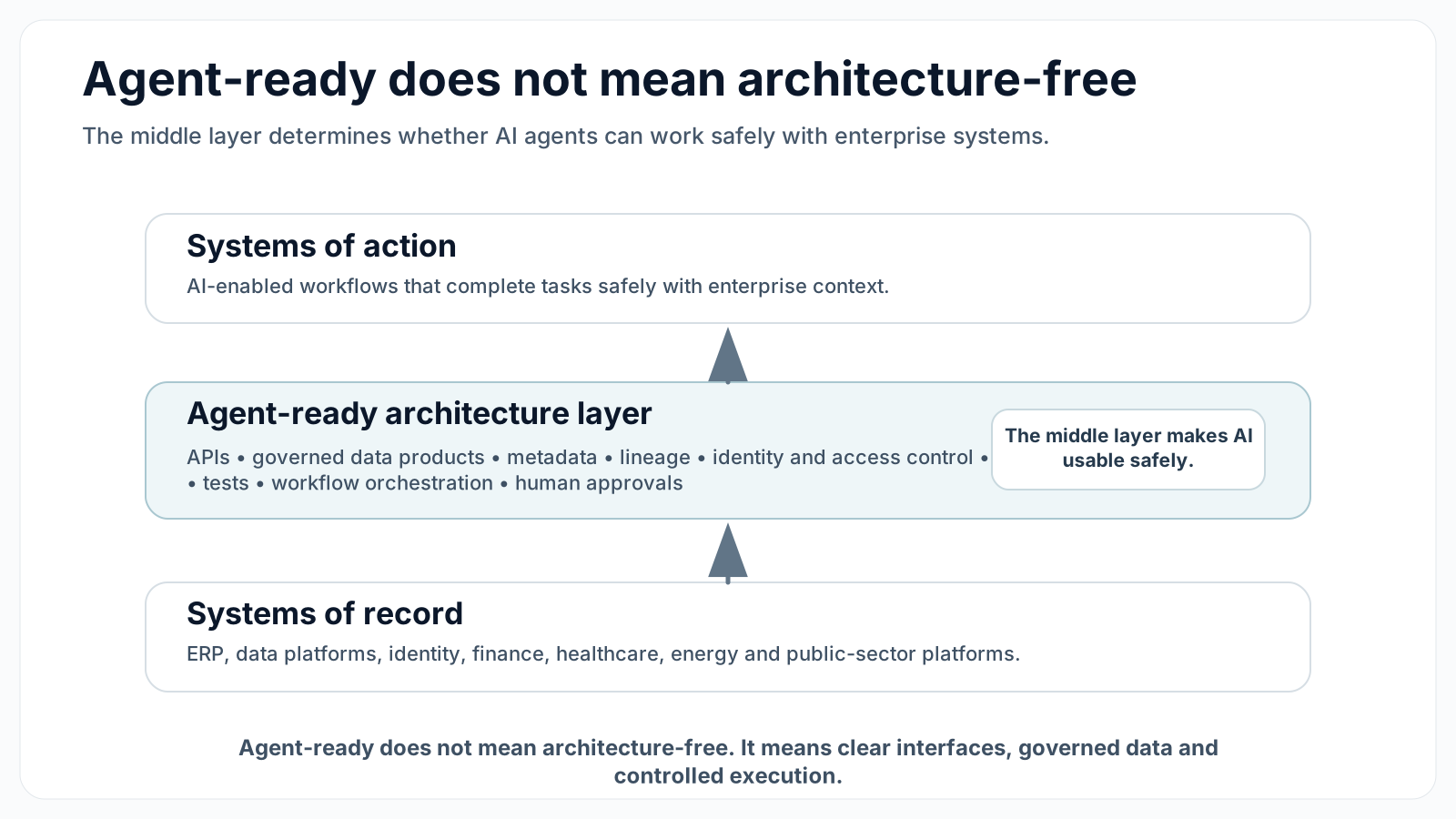
The answer is not to replace every enterprise platform with lightweight tools or custom AI agents. That would be naïve.
Many enterprise systems exist because businesses need reliability, auditability, regulatory controls, separation of duties, integration depth and operational continuity. ERP, data platforms, identity systems, finance systems, healthcare platforms, energy systems and public-sector infrastructure cannot be replaced by “simple tools” without serious risk.
The winning products will not necessarily be the simplest.
They will be the ones where complexity is:
- explicit, not hidden;
- modular, not monolithic;
- documented, not tribal;
- observable, not opaque;
- governed, not improvised;
- API-accessible, not screen-dependent;
- automatable, not manually stitched together;
- explainable to both humans and AI agents.
In other words, enterprise-grade will increasingly mean agent-ready.
From systems of record to systems of action
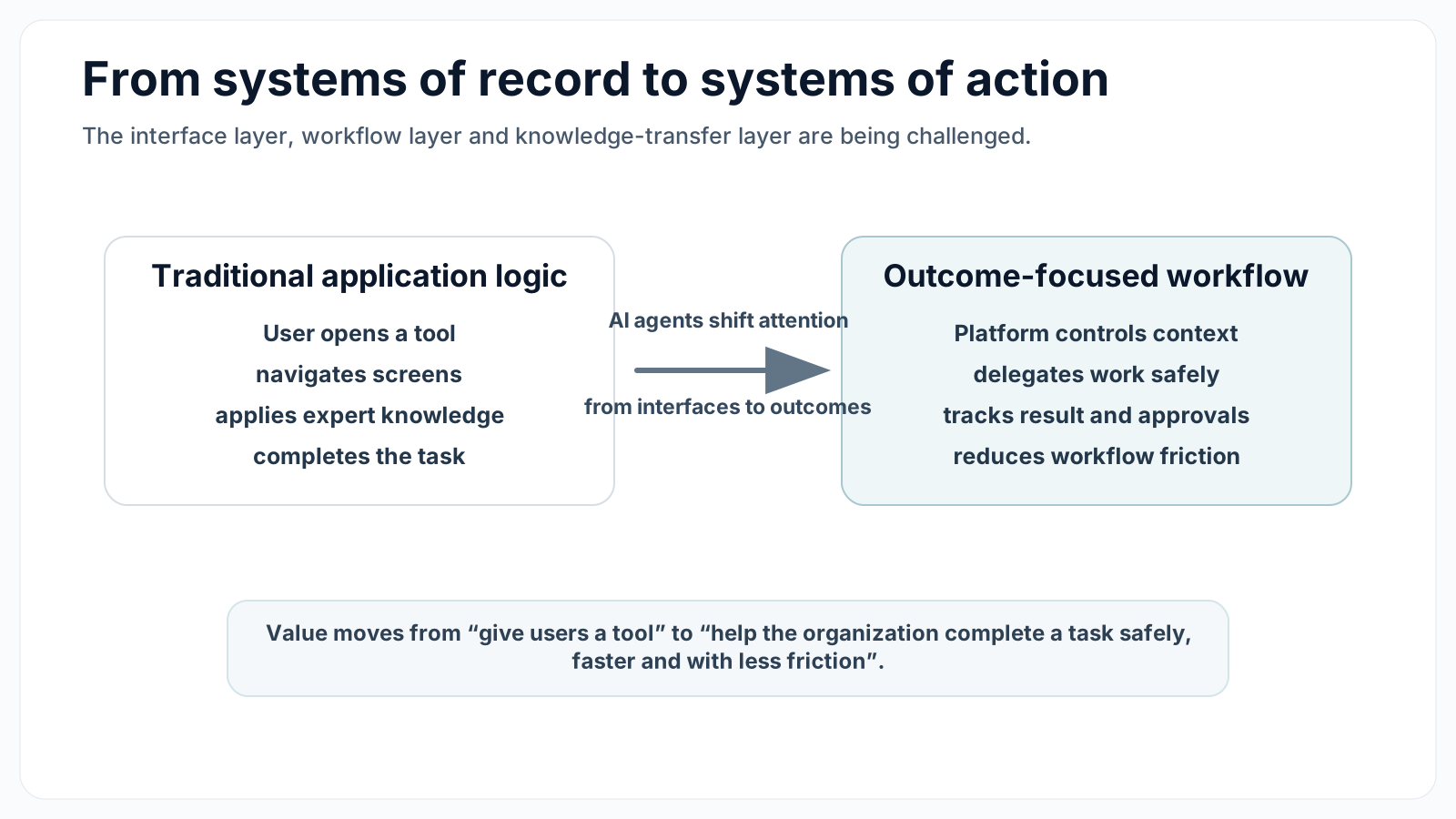
Traditional enterprise applications were built around users entering, searching and processing information. AI agents shift attention from interfaces to outcomes.
Klarna’s AI assistant is a good example. According to OpenAI, within its first month the assistant handled 2.3 million conversations, two-thirds of Klarna’s customer service chats, did the equivalent work of 700 full-time agents and reduced customer resolution time from 11 minutes to less than two.
In finance, Anthropic has launched task-specific agents for work such as pitchbooks, audits and credit memos. Reuters reports that Anthropic is deepening its finance push with AI agents tailored for banks and insurers, with adoption from institutions such as Goldman Sachs, Visa, Citi and AIG.
Gartner also describes a broader movement away from assistive AI toward outcome-focused workflows. In this model, execution gradually moves out of traditional interfaces and into platforms that control enterprise context and safely delegate work to policy-bound agents.
These examples show the same pattern: value moves from “give users a tool” to “help the organization complete a task safely, faster and with less friction”.
That is a major challenge for enterprise products whose value proposition is still built around seat-based access, heavy UI training and human navigation through complex workflows.
Signals from the market
Several recent cases show the same direction of travel.
Freshworks announced it would cut 11% of its workforce as it adapts to AI-driven changes in the software industry. Reuters reported that Freshworks’ CEO said AI now writes over half of the company’s code and is automating routine tasks.
Atlassian announced a reduction of roughly 10% of its workforce while shifting investment toward AI and enterprise sales. Reuters reported that the company acknowledged AI is changing the mix of skills and the number of roles needed in some areas.
Shopify launched an AI Store Builder that can generate complete online store layouts from descriptive keywords, reducing the time and resources required to start.
DualEntry, an AI-native ERP startup, raised $90 million to challenge the ERP market with rapid implementation and a “NextDay Migration” approach that aims to reduce migration time from months to 24 hours.
These examples do not prove that enterprise platforms will disappear.
They prove something more important: the interface layer, the workflow layer and the knowledge-transfer layer are all being challenged.
If a product requires months of onboarding, specialist configuration and human navigation through complex screens, the business will increasingly ask whether that complexity is still justified.
The new architectural question
The strategic question for businesses is no longer only:
Which platform should we buy?
It is increasingly:
Which parts of our enterprise landscape must remain stable systems of record, and which parts should become AI-enabled systems of action?
This requires architecture, not hype.
IBM’s 2025 CEO study found that only 25% of AI initiatives had delivered expected ROI over the previous years, and only 16% had scaled enterprise-wide. The same study reported that 50% of CEOs said rapid technology investment had resulted in disconnected technology within their organizations.
McKinsey makes a similar point in its work on the AI-agent and ERP divide: AI experiments often struggle to scale when they are not connected to the underlying processes, data, people and technologies that run the enterprise.
So the question is not whether organizations should use AI agents.
The question is whether their enterprise architecture is ready for them.
What businesses should ask now
Before buying another platform, launching another AI pilot or replacing another system, business and technology leaders should ask:
- Which parts of our current enterprise landscape are truly complex because the business is complex — and which parts are complex because of historical decisions, vendor lock-in or poor architecture?
- Where do we depend on tacit knowledge? Which processes can only be explained by one senior developer, one analyst, one consultant or one product expert?
- Could a new team or AI agent understand our system from documentation, metadata, APIs and tests — or only through months of knowledge transfer?
- Which enterprise products are systems of record that must remain stable, and which are mostly workflow or user-interface layers that could be simplified, automated or replaced?
- Are we buying software capabilities, or are we buying access to screens that humans must still operate manually?
- Where do we have tool sprawl? Do multiple systems solve overlapping problems with different data models and inconsistent ownership?
- Which parts of our software spend have unclear ROI? Are licenses, customizations, integrations and support costs still justified by measurable business value?
- Are our data and processes agent-ready? Do we have trusted data, ownership, lineage, APIs, test coverage, logging and human approval points?
- What would happen if a critical expert or vendor consultant disappeared tomorrow?
- Can we explain why our architecture is complex — in business language?
What architects should do
The practical response is not a massive replacement programme. It is an architectural assessment of complexity.
Organizations should identify where complexity creates value and where it only creates dependency.
1. Run a complexity audit
Assess systems against six dimensions:
- business criticality;
- cost of ownership;
- knowledge-transfer burden;
- customization depth;
- integration and API maturity;
- AI and automation readiness.
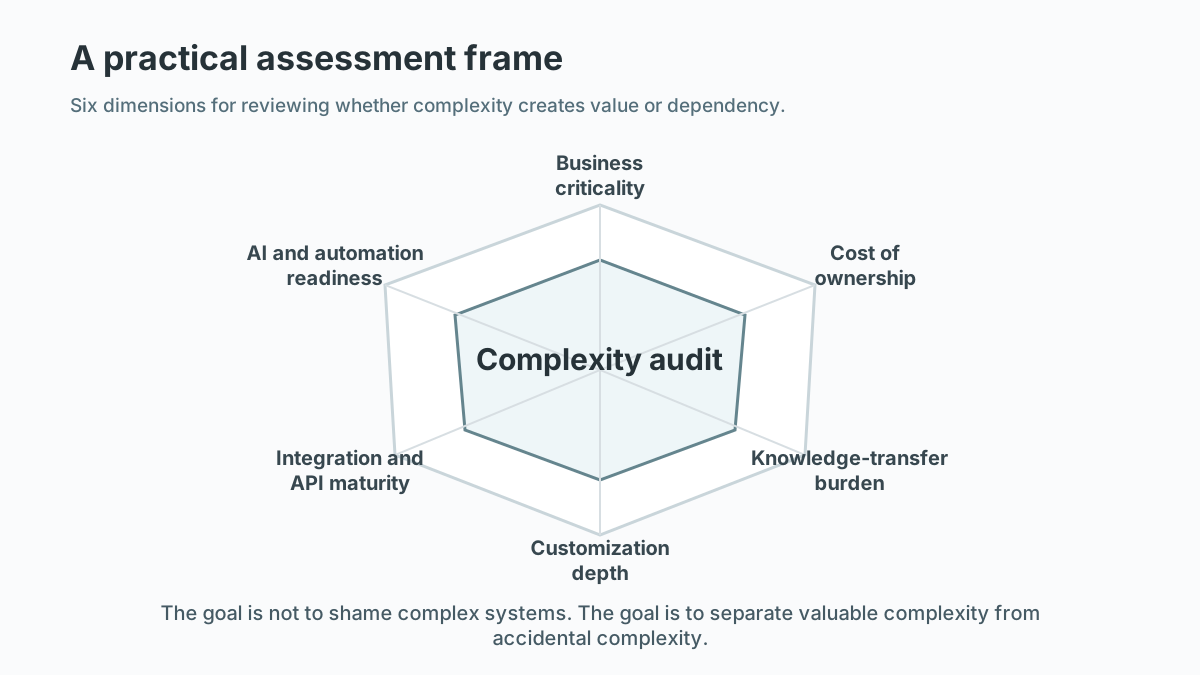
The goal is not to shame complex systems. The goal is to separate valuable complexity from accidental complexity.
2. Build an agent-ready architecture layer
Before deploying many AI agents, prepare the landscape:
- clean APIs;
- governed data products;
- metadata and lineage;
- identity and access control;
- audit logging;
- test automation;
- workflow orchestration;
- human-in-the-loop controls.
This is where enterprise and data architecture become more important, not less.
3. Treat legacy systems as knowledge assets, not only as technical debt
Some legacy systems contain decades of business rules. Do not rush to replace them blindly.
First extract and document:
- business rules;
- data models;
- process logic;
- integrations;
- exceptions;
- operational dependencies;
- ownership and accountability.
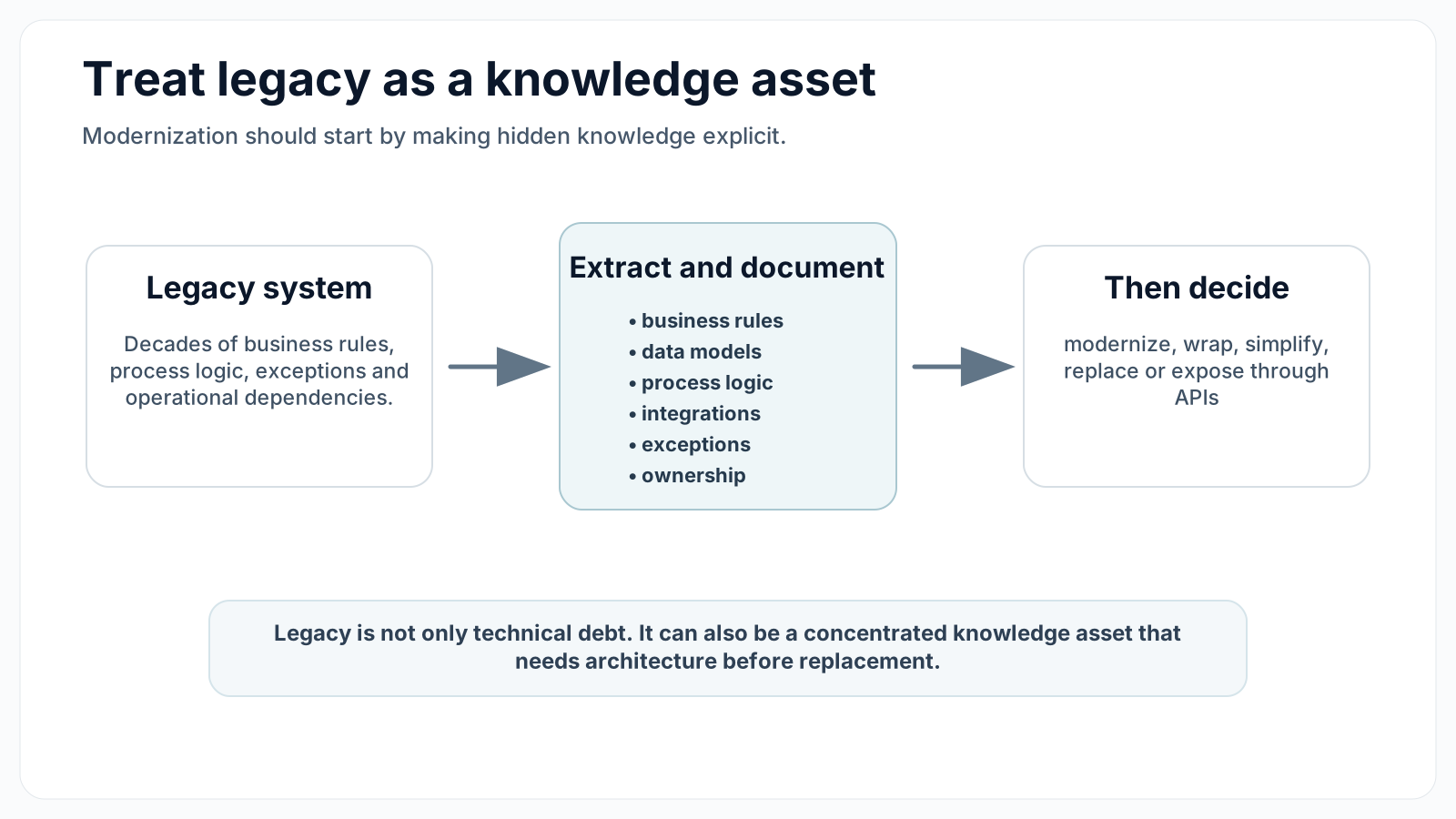
Then decide whether to modernize, wrap, simplify, replace or expose through APIs.
4. Use AI where workflow friction is highest
Good first candidates include:
- service desk;
- documentation search;
- metadata discovery;
- test generation;
- data quality triage;
- report explanation;
- migration analysis;
- customer support;
- onboarding and knowledge transfer;
- repetitive analyst, developer or tester tasks.
Poor first candidates include:
- high-risk autonomous decisions without controls;
- undocumented processes;
- poor-quality data;
- systems without logging;
- workflows where nobody owns the outcome;
- processes with unclear regulatory or ethical boundaries.
5. Move from vendor evaluation to architecture evaluation
When assessing enterprise products, ask:
- How fast can a new team become productive?
- How much specialist knowledge is required?
- How transparent is the business logic?
- How easy is it to export metadata?
- How open are the APIs?
- How much of the workflow can be automated?
- How expensive is migration away?
- How does the product support AI governance and auditability?
- Does it reduce complexity or move it somewhere else?
This changes the conversation.
The decision is no longer only about features, licenses or vendor reputation. It is about whether the product helps the organization become more understandable, adaptable and agent-ready.
Key takeaway
Enterprise software is not becoming irrelevant.
But unjustified enterprise complexity is becoming harder to defend.
AI agents, low-code platforms and AI-native development do not remove the need for enterprise architecture. They make architecture more important because they expose where business logic, data, ownership and process control are unclear.
Conclusion: complexity must become intentional
The future of enterprise software will not be defined by a simple choice between large platforms and lightweight tools.
It will be defined by the ability to make complexity intentional.
Enterprise products will remain necessary where they provide trust, resilience, governance, compliance and scale. But they will be questioned wherever they mainly create dependency, slow onboarding, hidden logic, manual coordination and expensive knowledge transfer.
The strongest platforms will not necessarily be the simplest. They will be the ones where complexity is explicit, governed, modular, observable and understandable — for people, teams and AI agents.
Enterprise software is not at risk because it is complex.
It is at risk when its complexity can no longer be explained, governed or justified.
Norwegian version: Når kompleksitet blir en belastning: enterprise-produkter i en tid med AI-agenter